
The Math of a Gig: How to Price Tickets for Small Events Without Going Broke
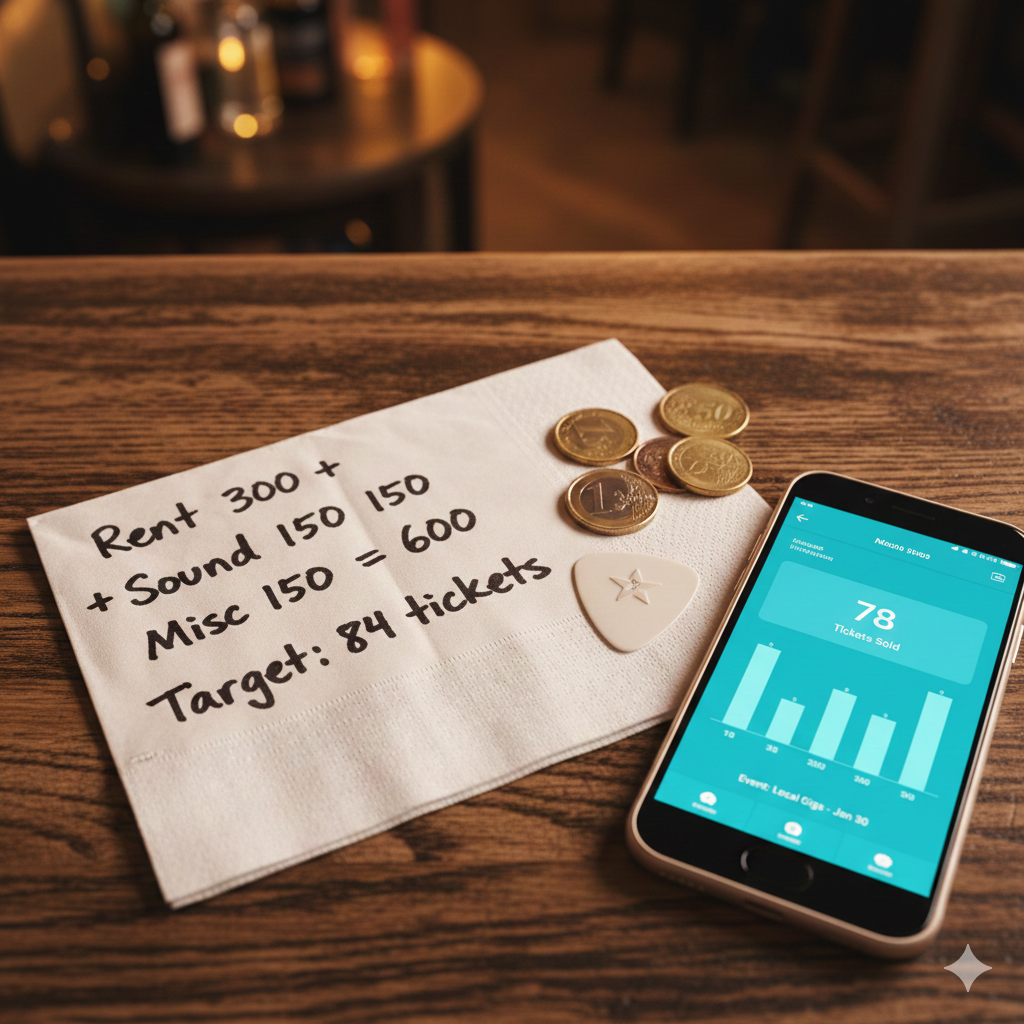
You booked a venue. You found a band (or maybe you are the band). You’re ready to launch sales. Then you freeze at the input field: "Price per ticket."
Put €10? It feels too cheap, and you might lose money. Put €25? It feels expensive, and you’re scared nobody will come.
For small events (50–150 people), most organizers guess. They look at what the club next door is charging and copy it. This is how you lose money.
Pricing isn't about "vibes." It’s about cold, hard arithmetic. Here is how to calculate a number that covers your bills and actually fills the room.
1. Know Your Burn Rate (The Real Costs)
The moment you sign the venue contract, you are in the red. The venue owner doesn't care if nobody shows up; they still want their rent.
Write down every euro that will leave your pocket before the doors open:
- Venue Guarantee: €300 (Often a minimum bar spend or rent).
- Sound Engineer: €150 (Never skimp on this).
- Marketing: €50.
- Rider: €50 (Beers and pizza for the talent).
- The "Oops" Fund: €50 (Broken cables, taxis, forgotten adapters).
Total Burn: €600. This is your zero line. You need to clear this just to sleep at night.
2. The "Guest List" Tax
Here is what beginners forget: Not everyone in the room pays.
If your venue holds 150 people, you aren't selling 150 tickets. The band has partners. You have close friends who help out. There’s always a photographer or a bartender’s friend.
Let's say your "Guest List" is modest: 10 people. These 10 people drink, breathe, and take up space, but they contribute €0 to the door revenue.
- Total Capacity: 150
- Sellable Capacity: 140
3. The 60% Safety Net
If you calculate your ticket price assuming you will sell all 140 tickets, you are gambling. Sold-out shows are great, but they are rare for newcomers.
Plan to break even at 60% attendance. If you can pay your bills with the room half-full, everything after that is pure profit. If you need a full house just to survive, you’re stressed.
- Target Sales: 60% of 140 = 84 tickets.
4. Doing the Math (The Base Price)
Now, divide your burn rate by your safety net target.
€600 / 84 tickets = €7.14
This is your Break-Even Price. If you net less than €7.14 per ticket, you are paying out of your own pocket.
5. The "Platform Tax" (Where Most Organizers Lose Money)
This is the most critical step. On many legacy platforms, if you set the price at €10.00, the platform charges you a fee (e.g., 5% + €0.50).
-
Scenario A (Legacy Platform):
- You charge: €10.00
- Platform takes: -€1.00
- You get: €9.00
- Result: You just lost €84 of revenue (across 84 tickets). That wipes out your entire "Oops Fund" and Marketing budget!
-
Scenario B (The TixFlow Way):
- We believe the ticket price belongs to you.
- You set: €10.00.
- Buyer pays: €10.00 + Booking Fee.
- You get: €10.00.
Always calculate your price based on what lands in your bank account, not what the customer sees.
6. The "Price of Dignity" (Final Amount)
Now that we know we need €7.14 net to survive, and we are using TixFlow to protect our margin, let's add some profit.
- Base Need: €7.14
- Profit/Buffer: ~€2.86
- Final Price: €10.00
Wait, isn't €10 too much? Actually, there is a psychological trap in being too cheap. If people see a live concert for €5 (less than the price of a pint), they subconsciously assume the band is rehearsing or the sound system sucks.
A price between €10 and €15 signals legitimacy. It tells the audience: "We prepared a professional show." Ironically, raising the price often increases sales because it raises the perceived value of the night.
Summary
- Calculate your fixed costs (Total €600).
- Subtract the Guest List (10 people).
- Target 60% attendance (84 tickets).
- Crucial: Ensure your platform allows you to pass fees to the buyer (like TixFlow), otherwise add +10% to cover the loss.
- Set a price that signals quality (€10+).
Don't guess. Do the math. Then go create a great show.